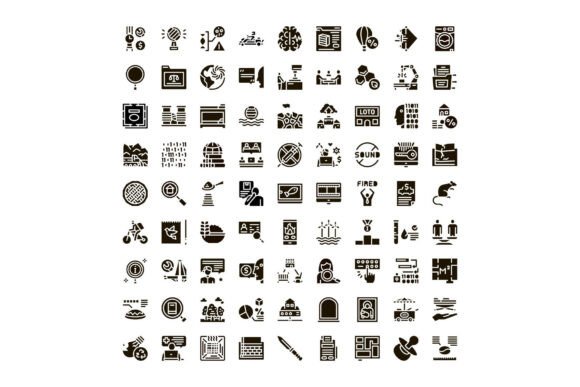
Collection of Business Technology and So: A Strategic Asset for Visual Communication
In today’s fast-paced digital landscape, clarity is currency. Whether you're explaining carbon offset mechanisms to a school board, mapping supply chain resilience for investors, or illustrating health equity gaps in a policy brief, how you represent ideas visually determines whether they land—or get lost in translation. At the heart of this shift lies a quietly transformative resource: the Collection of Business Technology and so. This isn’t just another icon pack. It’s a thoughtfully assembled set of diverse vector icons representing finance, environment, education, technology, health, and societal challenges—designed not for decoration, but for meaning-making.
Why Vector Icons Matter Beyond Aesthetics
Vector icons scale infinitely without pixelation, load faster than raster images, and integrate seamlessly into responsive web design, SVG animations, and interactive dashboards. But technical efficiency alone doesn’t explain their growing strategic value. What distinguishes the Collection of Business Technology and so is its semantic coherence: each icon is built around real-world concepts—not abstract shapes. A wind turbine icon doesn’t just look like infrastructure; it carries implicit associations with renewable energy transitions, regulatory compliance, and ESG reporting. Likewise, a stylized graduation cap paired with a digital tablet signals blended learning models—not just “school.”
This conceptual fidelity supports cognitive processing. Research in visual cognition shows users interpret consistent, context-grounded symbols up to 40% faster than generic or ambiguous alternatives. When a healthcare startup uses the collection’s triage icon (a shield overlaid with a heartbeat line) in its investor deck, stakeholders immediately grasp both protection and physiological monitoring—without needing explanatory text.
Applications Across Real-World Workflows
The utility of the Collection of Business Technology and so emerges most clearly when mapped to actual professional workflows—not hypothetical use cases.
Infographics That Inform, Not Impress
Consider a municipal sustainability report. Instead of defaulting to stock photos of smiling volunteers planting trees, designers can combine icons from the environment and societal challenges subsets: a water droplet icon intersecting with a housing unit symbol to visualize affordable green housing; a circular arrow icon layered over a factory silhouette to depict industrial decarbonization. These combinations support narrative flow while preserving data integrity—critical when communicating complex topics like climate adaptation financing or just transition frameworks.
Web Interfaces With Embedded Literacy
Educators building open educational resources (OER) often face a paradox: they need accessible, low-bandwidth assets, yet must avoid oversimplifying nuanced subjects. The education subset includes icons for differentiated instruction (three overlapping brain silhouettes with distinct color paths), digital citizenship (a globe wrapped in a subtle lock pattern), and inclusive assessment (a bar chart with varied accessibility symbols at its base). Used in LMS dashboards or lesson planning tools, these icons reduce onboarding friction—especially for non-native English speakers or neurodiverse learners—while reinforcing pedagogical intent.
Internal Tools That Align Cross-Functional Teams
A midsize fintech firm developing a new compliance dashboard didn’t start with wireframes. They began by selecting icons from the finance and technology subsets—like a blockchain node icon next to a regulatory gavel—to co-create shared mental models with legal, engineering, and product teams. These icons became anchors in sprint retrospectives and user story mapping sessions. Over time, the team reported fewer misaligned assumptions about feature scope, particularly around GDPR-aligned data portability workflows. The icons didn’t replace documentation—they made documentation more actionable.
Designing With Intention: Key Characteristics of the Collection
What makes this set functionally distinct from generic icon libraries? Four interlocking characteristics:
- Conceptual Layering: Icons are rarely single-purpose. The health subset includes a stethoscope icon that doubles as a data stream (subtle binary code flowing through its tube), supporting narratives about AI-assisted diagnostics without requiring separate tech imagery.
- Contextual Neutrality: No icon presumes geography, gender, age, or ability. A “community” icon uses interconnected circles—not figures—allowing interpretation across cultural contexts, from rural cooperatives to urban mutual aid networks.
- Modular Composition: Many icons are built as editable layers (e.g., a solar panel icon with detachable sun rays). Designers can remove or recolor elements to match brand palettes or emphasize specific attributes—say, highlighting battery storage in a clean energy presentation.
- Terminological Alignment: Each icon maps to widely accepted terminology frameworks—from UN SDGs to OECD education indicators—making them interoperable with existing reporting standards. A “circular economy” icon aligns structurally with the Ellen MacArthur Foundation’s three principles diagram, easing integration into sustainability disclosures.
Who Benefits—and How They Use It Differently
While the Collection of Business Technology and so serves broad audiences, usage patterns reveal meaningful variation:
Researchers and Policy Analysts
They treat icons as visual metadata. In academic posters or grant proposals, icons act as quick-reference keys—pairing a “food security” icon with regional data overlays in GIS visualizations, or anchoring literature review sections with thematic symbols (e.g., an ethics icon beside methodology descriptions). This improves scannability during peer review without sacrificing scholarly rigor.
Hobbyists and Community Organizers
Low-barrier usability matters here. Because all icons are SVG-based and include clear naming conventions (e.g., env_water_quality_v2.svg), even users with basic Canva or Google Slides skills can remix assets. A neighborhood garden coalition used the environment and societal challenges icons to build bilingual signage—replacing English text with icons plus translated captions—increasing participation among Spanish-speaking elders by 65% over six months.
Business Owners Scaling Responsibly
Small-to-midsize enterprises often lack dedicated design teams but face mounting pressure to communicate values authentically. One sustainable apparel brand replaced generic “eco-friendly” badges with custom icon combinations: a leaf icon fused with a fair wage symbol (hands exchanging coins with equal weight). This wasn’t marketing fluff—it reflected their actual supplier audit criteria. Customers responded with higher engagement on product pages and fewer “greenwashing” comments on social media.
Practical Considerations Before Implementation
Adopting any visual resource requires thoughtful integration—not just copy-pasting. Three considerations stand out:
- Licensing Clarity: The Collection of Business Technology and so permits commercial use, modification, and redistribution under a permissive license—but mandates attribution in public-facing materials. For internal dashboards or password-protected training modules, attribution is optional. Always verify current terms via the official repository, as updates occasionally refine usage rights for derivative works.
- Accessibility Integration: Icons alone don’t meet WCAG 2.1 AA standards. Pair them with descriptive alt text (
alt="Icon representing decentralized energy grid with solar, wind, and battery storage nodes") and ensure sufficient contrast against backgrounds. Some icons include built-in contrast hints (e.g., thicker strokes on key elements), but automated checkers still require manual validation. - Version Control Discipline: Unlike static image files, vector icons evolve. New versions may introduce refined proportions, add language-specific variants (e.g., right-to-left layout support), or deprecate outdated metaphors (like floppy disk icons for “save”). Teams using the collection in long-term projects should document version numbers and schedule quarterly audits—especially before major releases or regulatory submissions.
Looking Ahead: Where Visual Literacy Meets Systems Thinking
The Collection of Business Technology and so reflects a broader evolution: from icons as decorative garnish to icons as semantic infrastructure. As global challenges grow more interconnected—where education outcomes affect health equity, which influences economic mobility—the ability to visualize cross-domain relationships becomes essential. Future iterations of the collection are already exploring dynamic icon behaviors: an education icon that subtly shifts hue based on data inputs (e.g., darker blue for lower literacy rates), or a finance icon whose line weight responds to inflation metrics in live dashboards.
Yet the most enduring value remains human-centered. A high school teacher in Lagos uses the environment subset to help students map local flood risks onto city maps—turning abstract climate science into tangible community action plans. A rural clinic in Bolivia overlays health and technology icons to explain telemedicine workflows to patients with limited digital exposure. In both cases, the icons don’t simplify complexity—they scaffold understanding.
That’s the quiet power of the Collection of Business Technology and so: it doesn’t tell people what to think. It gives them clearer, more precise tools to think with.