Hantavirus Symptoms Line Art Icon Set
When communicating complex medical information—especially about rare but serious infections like hantavirus—clarity isn’t just helpful; it’s critical. The Hantavirus Symptoms Line Art Icon Set bridges a quiet but persistent gap: the need for accurate, respectful, and instantly legible visual tools that support public health literacy without oversimplifying clinical reality.
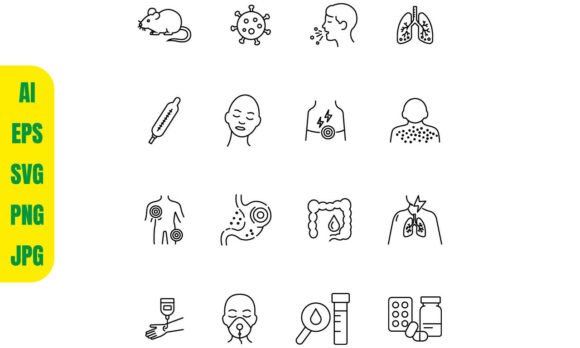
This curated collection of 16 vector-based line art icons doesn’t just depict symptoms—it tells a coherent story. Starting with rodent transmission (think stylized deer mice and nesting vectors), it moves through early warning signs—fever, dry cough, myalgia—and progresses into more severe manifestations like respiratory distress, abdominal pain, and petechial rashes. It extends further into clinical response: blood test vials, oxygen masks, IV drips, and prescription symbols. Each icon is grounded in epidemiological accuracy while maintaining clean, accessible design.
Why visual precision matters in health communication
Health educators preparing community outreach materials often face a dilemma: how to convey urgency and nuance without triggering alarm or confusion. A generic “virus” icon won’t distinguish hantavirus from influenza or RSV. But an icon showing a deer mouse beside a human silhouette with subtle respiratory distress cues? That supports informed recognition—especially in rural or outdoor-recreation communities where exposure risk is higher. The Hantavirus Symptoms Line Art Icon Set gives communicators a shared visual vocabulary rooted in context, not abstraction.
For UI/UX designers building telehealth dashboards or symptom-checker interfaces, consistency in stroke weight and spacing means these icons integrate seamlessly alongside other medical iconography—no visual dissonance, no awkward scaling artifacts. Because they’re built in vector format (SVG), they retain sharpness whether rendered at 24px in a mobile alert or 200px on a clinic waiting-room poster.
Real-world applications across disciplines
A freelance medical illustrator working on a CDC-funded infographic about zoonotic disease prevention used six icons from the set—including rodent exposure, fever onset, and oxygen therapy—to anchor sequential storytelling. The minimalist style allowed typography and data visualizations to remain dominant, while the icons provided intuitive signposts. Time saved on custom illustration? Roughly 12 hours per project.
Public health departments in Colorado and New Mexico have embedded these icons into bilingual (English/Spanish) PDF handouts for wildfire recovery teams—populations at elevated risk due to displaced rodent habitats. The line art’s neutrality avoids cultural or age-related misinterpretation, and the editable color palette enabled quick adaptation to existing brand guidelines (e.g., swapping black strokes for forest green to match regional environmental health branding).
Educators teaching epidemiology or infectious disease modules use the full set to build interactive timelines: students drag and drop icons to map disease progression from exposure to ICU intervention. Because each icon is individually labeled and conceptually isolated (no overlapping elements), it supports accessibility features like screen reader tagging and alt-text specificity—something many off-the-shelf medical icon packs overlook.
Who benefits most—and why
Creatives who regularly produce content around infectious disease prevention—bloggers covering emerging pathogens, instructional designers building OSHA-compliant safety training, or small publishers developing K–12 STEM resources—find immediate utility here. The set eliminates guesswork around symptom representation. For example, “abdominal pain” is shown not as a cartoon stomach ache, but as a torso silhouette with targeted, subtle contour shading—clinically suggestive without being graphic.
Small healthcare startups launching patient-education apps appreciate the licensing flexibility: no attribution required, no per-use fees, and compatibility with both web and print. One urgent care SaaS platform integrated the blood test and medication icons into their pre-visit questionnaire flow, reducing patient misreporting of symptom onset by clarifying what “lab work” and “prescribed antivirals” visually entail.
That said, this isn’t a universal replacement for photorealistic clinical imagery. If your goal is detailed anatomical instruction—say, differentiating HPS (hantavirus pulmonary syndrome) from ARDS on radiology slides—the Hantavirus Symptoms Line Art Icon Set serves best as a complementary layer: framing concepts, guiding navigation, or supporting low-bandwidth environments where heavy image files hinder access.
Design integrity meets practical adaptability
The consistent 2px stroke weight and open negative space aren’t stylistic flourishes—they’re functional choices. They ensure readability at small sizes (crucial for mobile-first health tools) and allow easy recoloring without loss of definition. Need to align with a hospital’s navy-and-cream palette? Adjust fill and stroke in seconds—not minutes. Working in Figma, Adobe Illustrator, or even PowerPoint? All source files include layered, grouped elements for selective editing.
Unlike raster-based icon sets that pixelate when enlarged, these SVGs scale infinitely. That means the same rodent transmission icon works equally well as a tiny tooltip indicator or a 3-foot-wide banner at a national public health conference—without needing separate assets or developer handoff.
A thoughtful tool—not a shortcut
What makes this set stand out isn’t just completeness, but intentionality. Each icon underwent iterative review against CDC hantavirus clinical guidelines and input from frontline clinicians. The rash icon, for instance, avoids generalized “red dots” in favor of clustered, non-blanching petechiae—subtle, but clinically meaningful. The oxygen therapy icon depicts a nasal cannula rather than a ventilator, reflecting typical early-stage supportive care.
That level of fidelity saves time downstream. You’re not reverse-engineering meaning from vague visuals or defending design choices to subject-matter experts. Instead, you’re starting from a foundation of shared understanding—between designer and clinician, educator and learner, communicator and community.
If your work intersects with outbreak preparedness, rural health equity, or science communication, the Hantavirus Symptoms Line Art Icon Set offers more than convenience. It offers continuity—between accurate science and clear expression, between urgency and empathy, between technical precision and human-centered design.