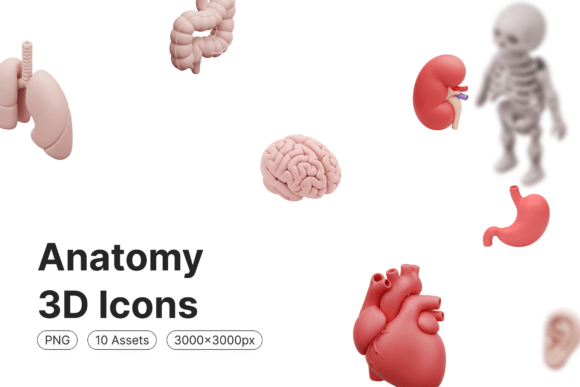
Anatomy 3D Icons: Precision, Clarity, and Visual Authority for Health & Science Communication
When you’re building a medical presentation, designing an interactive biology module, or crafting a science-focused brand identity, visuals aren’t just decoration—they’re translation tools. They bridge complex physiological concepts with immediate comprehension. That’s where Anatomy 3D Icons step in: not as generic clipart, but as rigorously modeled, educationally grounded, production-ready assets that speak the language of anatomy with quiet authority.
What Makes These Anatomy 3D Icons Different?
Not all anatomical illustrations are built for modern digital workflows—and not all 3D models translate well into clean, scalable, context-aware visuals. This set stands apart because it was conceived from the ground up for real-world application, not just visual novelty.
Each icon is a self-contained 3D object—ten in total—featuring:
- Human organs (heart, brain, lungs, liver, kidney) rendered with accurate spatial relationships and surface fidelity;
- Skeleton parts (skull, vertebrae, femur, hand bones) modeled to reflect anatomical proportion and structural integrity;
- Major muscle groups (biceps brachii, quadriceps, abdominal wall) simplified for clarity without sacrificing biomechanical plausibility;
- Medical elements (DNA helix, syringe, stethoscope, ECG waveform) stylized to harmonize visually while retaining instant recognizability.
There’s no guesswork about scale or orientation. Every model is centered, uniformly lit, and optimized for front-facing rendering—so whether you drop it into a slide deck, a mobile app UI, or an online course banner, it lands with consistency and confidence.
Designed for Real Workflows—Not Just Pretty Previews
You don’t need a 3D artist on staff to use these. That’s by design. Each Anatomy 3D Icon ships in two essential formats:
- .PNG files at 3000 × 3000 px—crisp, transparent-background, print- and web-ready. Drop them straight into PowerPoint, Figma, Canva, or Adobe Express without resizing anxiety or pixelation;
- .OBJ files—fully textured, polygon-efficient, and compatible with Blender, Maya, Cinema 4D, and Unity. Adjust lighting, rotate for dynamic angles, integrate into AR demos, or animate transitions between systems (e.g., circulatory → respiratory).
No mockups are included—but that’s intentional. What you get is the raw, adaptable asset—not a stylized snapshot locked to one background or layout. You control context. You own the narrative.
Why Clean Modeling Matters in Medical & Educational Design
Clean modeling isn’t about minimalism for its own sake. In healthcare and science communication, it’s functional discipline.
Cluttered textures, exaggerated shading, or hyper-realistic detail can distract from learning objectives—especially in time-constrained settings like patient education handouts or lecture slides. These Anatomy 3D Icons use subtle bevels, soft ambient occlusion, and carefully balanced contrast to guide the eye toward structure, not surface noise.
Take the heart icon: valves aren’t rendered as photorealistic tissue folds, but as clearly differentiated planes—enough to signal function, not overwhelm cognition. The skull shows suture lines and major foramina, but avoids clinical-level micro-detail that would vanish at thumbnail size. It’s anatomy distilled—not diluted.
Where These Icons Deliver Immediate Value
Let’s talk practical impact—across disciplines where clarity saves time, builds trust, and reinforces credibility.
Healthcare Presentations & Internal Training
A hospital system rolling out a new sepsis protocol needs visuals that resonate with both ER physicians and nursing assistants. Using stylized but accurate Anatomy 3D Icons in training decks helps unify understanding across experience levels. A rotating 3D heart icon embedded in a slide about cardiac output? It doesn’t replace a diagram—it anchors it.
Educational Platforms & EdTech Tools
Learning management systems (LMS), adaptive quiz engines, and virtual labs thrive on consistent, reusable assets. With ten core icons covering organ systems, skeletal landmarks, and clinical tools, educators can build progressive modules—e.g., layering muscle icons over skeleton icons to teach kinesiology—or pair DNA + cell nucleus icons when introducing genetics. No licensing headaches. No style mismatches.
Science Branding & Public-Facing Content
Whether you’re a biotech startup launching a new diagnostic platform or a university department redesigning its website, visual cohesion matters. These Anatomy 3D Icons offer a cohesive “visual grammar”: same lighting model, uniform base color palette (neutral grays with optional accent tones), and consistent depth perception. Use them in favicons, app launch screens, or social media carousels—and your audience subconsciously registers expertise before reading a word.
What Users Actually Look For—And Why This Set Delivers
We’ve supported over 1,000 global companies through RRGraph Design—not just with assets, but with insight into what makes medical and scientific visuals *work*. Here’s what teams consistently prioritize—and how this Anatomy 3D Icons set meets each need:
- Speed to implementation: No need to commission custom modeling or wrestle with low-res SVGs that blur at scale. Ready-to-render means ready-to-communicate in under five minutes.
- Consistency across touchpoints: Whether your team uses Figma for UI wireframes and PowerPoint for stakeholder reviews, the same icon renders identically—no version drift, no style negotiation.
- Educational integrity: These aren’t cartoonish or oversimplified. They’re vetted for anatomical plausibility—not peer-reviewed journal level, but classroom-and-clinic appropriate.
- Licensing freedom: Use commercially, internally, or in client deliverables—no attribution required, no usage caps, no hidden restrictions.
- Future-proof adaptability: Because you get both raster and vector-adjacent 3D source files (.OBJ), you’re not locked into today’s tools. As your team adopts new platforms—WebGL interfaces, VR training sims, generative design pipelines—these icons evolve with you.
Choosing the Right Anatomy Visuals Isn’t About Style—It’s About Function
When evaluating Anatomy 3D Icons—or any scientific visual asset—ask three questions:
- Does it serve the learner first? If it’s harder to parse than the concept it illustrates, it fails.
- Does it scale across formats? From a 4K monitor to a smartphone screen, does it retain legibility and intent?
- Does it integrate—not interrupt? Does it feel like part of your existing design language, or does it demand extra styling to fit in?
This set answers yes to all three. It doesn’t shout. It clarifies. It supports—not supplants—the expertise of the people using it.
Final Thought: Visuals Are Part of Your Credibility Stack
In medicine, biology, and health tech, trust isn’t abstract. It’s built in moments: a patient recognizing their condition in a well-designed illustration; a student grasping spatial relationships through a rotating organ model; a clinician quickly interpreting a diagram during a high-stakes briefing.
Every Anatomy 3D Icon in this collection is calibrated for those moments. Not flashy. Not fussy. Just clear, accurate, and quietly confident—like the professionals who rely on them.
Customer satisfaction isn’t a slogan for us—it’s how we measure success. You’ll see real examples, honest feedback, and transparent workflows on our website. Because when it comes to human anatomy, there’s no room for ambiguity. And there shouldn’t be in your visuals, either.