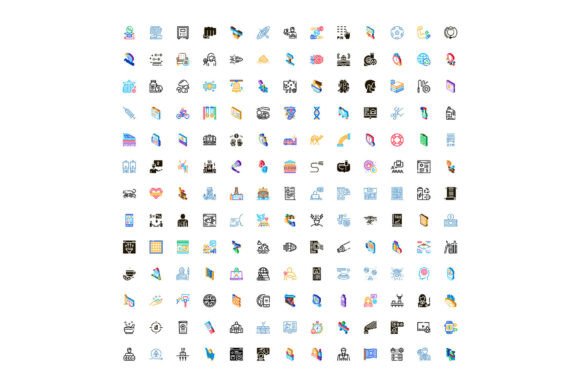
Variety of Business Technology and Globa: A Practical Evaluation for Design and Communication Needs
Designers, developers, educators, and business communicators frequently seek scalable, consistent, and thematically broad visual assets to support web interfaces, presentations, infographics, and applications. The Variety of Business Technology and Globa is a versatile vector icon set designed to meet this need. It comprises a curated collection of colorful line icons spanning six core domains: business, technology, health, environment, finance, and social topics. Built as a cohesive yet modular system, it prioritizes clarity, adaptability, and cross-context usability — from UI components to slide decks and data visualizations.
What the Set Offers—and What It Doesn’t
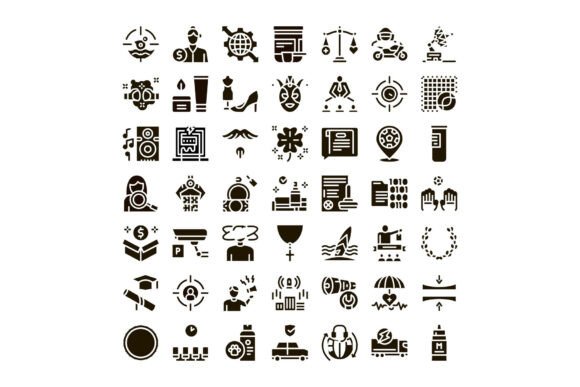
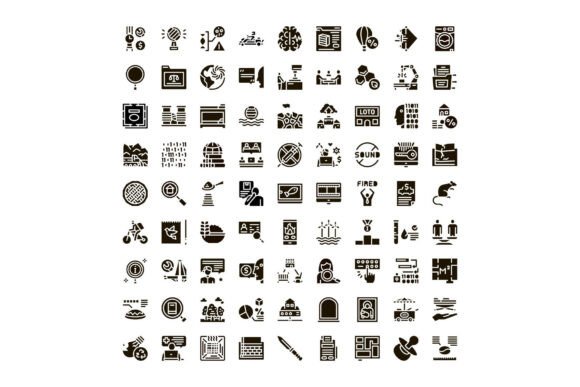
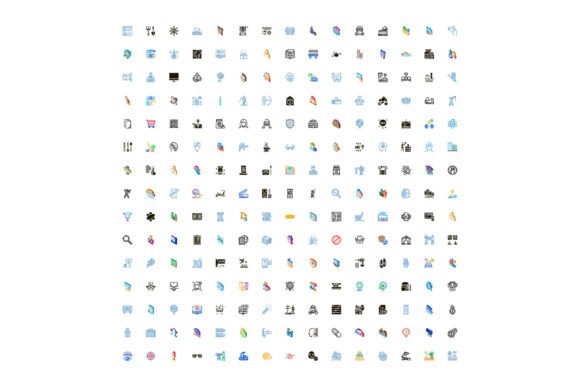
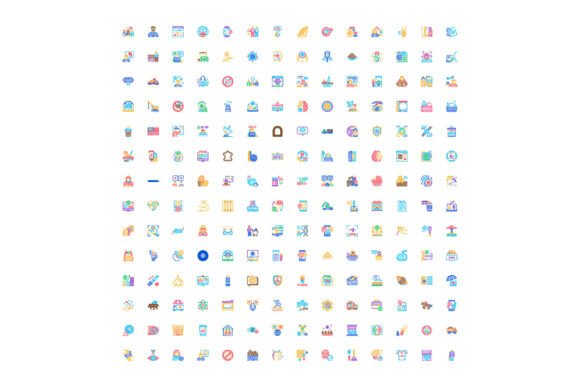
The Variety of Business Technology and Globa delivers 300+ hand-crafted, scalable vector icons in clean line style with subtle color accents. Each icon is optimized for legibility at small sizes and maintains visual harmony across categories. Unlike monochrome-only sets, its intentional use of restrained color supports quick topic recognition — for example, green tones for environment-related icons or blue hues for tech and finance. All icons are provided in SVG format, with optional PNG exports, and include consistent stroke weights, spacing, and alignment metrics.
It is not a design system with components, tokens, or code libraries. It does not include animated variants, 3D renderings, or photorealistic illustrations. Nor does it offer custom icon creation services or licensing for resale of derivative works. Its scope is intentionally focused: a ready-to-use, thematic icon library built for clarity and integration—not exhaustive coverage or stylistic experimentation.
Why Professionals Consider This Collection
Individuals evaluating the Variety of Business Technology and Globa often do so for specific practical reasons:
- Time efficiency: Assembling consistent, on-brand icons across multiple domains can be time-consuming. A unified set reduces research, testing, and alignment work.
- Thematic breadth: Projects spanning sustainability reporting, fintech dashboards, public health campaigns, or corporate ESG presentations benefit from icons that reflect interconnected topics without switching between disparate sources.
- UI and presentation readiness: The line-based aesthetic and balanced proportions translate well into both digital interfaces (e.g., dashboard navigation, status indicators) and static materials (e.g., annual reports, workshop handouts).
- Accessibility-aware foundation: While color adds meaning, the line structure ensures icons remain distinguishable in grayscale or high-contrast modes — an important baseline for inclusive design.
Key Benefits and Realistic Tradeoffs
One primary benefit is thematic coherence without sacrificing flexibility. Icons for “carbon footprint,” “blockchain,” “telehealth,” and “microfinance” share visual language, supporting narrative continuity in complex communications. The color palette is limited and purposeful — enhancing scannability without overwhelming interfaces.
However, tradeoffs exist. Because the set uses color selectively rather than universally, users needing full monochrome compatibility may need to adjust fills manually in some contexts. Also, while the collection covers broad categories, it does not include niche subtopics — such as specific medical devices, regulatory frameworks, or emerging tech like quantum computing — unless they align with its established scope. Users requiring highly specialized symbolism may still need supplemental assets.
Licensing is another consideration. The standard license permits broad usage across web, apps, and print, but excludes redistribution of the icons as standalone products. Teams planning to embed icons directly into white-label SaaS platforms should verify whether extended licensing applies.
Situations Where This Set Is a Strong Fit
The Variety of Business Technology and Globa works especially well when:
- You’re developing a cross-sector platform — for instance, a sustainability analytics tool that displays environmental KPIs alongside financial impact metrics and stakeholder engagement data.
- Your team maintains multiple content types (e.g., internal training modules, client-facing dashboards, investor presentations) and seeks visual consistency without maintaining separate icon libraries.
- You prioritize rapid prototyping and need production-ready SVGs that scale cleanly across responsive breakpoints and dark/light mode interfaces.
- Your audience includes non-technical stakeholders — educators, policymakers, community organizers — who rely on intuitive visual cues to interpret complex systems.
When Alternatives May Be More Appropriate
This collection is less ideal in scenarios where:
- Strict brand guidelines require absolute monochrome treatment. While adaptable, its default color application may demand extra customization effort compared to purely outline-based alternatives.
- Domain specificity outweighs thematic range. A healthcare startup building a HIPAA-compliant patient portal may prefer a medically validated icon set with clinical terminology precision over broader, general-purpose symbols.
- Animation or interactivity is central. If your interface relies heavily on micro-interactions — hover states, loading sequences, or morphing icons — you’ll likely need to build those separately, as the set provides static vectors only.
- Budget constraints limit licensing flexibility. Free or open-source icon libraries (e.g., Tabler Icons, Phosphor) offer comparable scalability and domain coverage at no cost, though with less integrated thematic cohesion across business and global development topics.
Making a Practical Decision
Evaluating whether the Variety of Business Technology and Globa aligns with your needs starts with clarifying your project’s scope and constraints. Ask yourself:
- What topics must the icons represent? Map your key themes against the set’s documented categories. If more than 70% of required concepts fall within business, tech, health, environment, finance, or social domains, coverage is likely sufficient.
- How will icons be implemented? If embedding directly into code via SVG sprites or React components, verify file naming conventions and folder structure match your workflow. Preview how icons render at 16px, 24px, and 48px in your target environments.
- Who interprets these visuals? Test a subset with representative users. Do colors aid understanding — or introduce ambiguity? Does the line style support quick recognition amid dense layouts?
- What’s your maintenance capacity? Consider long-term upkeep. A unified set simplifies future updates; however, if your organization regularly introduces new domain-specific concepts, assess whether the vendor offers periodic expansions or community-driven contributions.
Finally, compare against alternatives not just on features, but on integration cost. A free icon set may save money upfront but require hours of curation, resizing, and accessibility validation. Conversely, a premium set like Variety of Business Technology and Globa reduces decision fatigue and accelerates delivery — value that compounds across teams and projects over time.
In summary, the Variety of Business Technology and Globa serves professionals who value thematic breadth, visual consistency, and practical scalability — particularly in contexts where clarity across disciplines matters more than stylistic novelty or ultra-niche symbolism. Its strength lies not in being all things to all users, but in offering a thoughtful, execution-ready foundation for communicating interconnected global challenges and opportunities.